Representing Roles
One of the hardest parts of creating the theatre ontology was deciding how to represent roles. It’s arguably the most important part too (a theatre archive which doesn’t say who did what is pretty useless).
The Problem
Basically, the problem that needed solving is that a Person (represented using foaf:Agent) does some stuff in a particular project. For example, Alice directed Theatre company foo’s production of Macbeth. Here Alice is the Agent, Theatre company foo’s production of Macbeth is the Project and directing is the stuff they did.
Solution 1
The first approach that can be taken is nice and simple: each stuff they did becomes a predicate linking the subject (Agent) and object (Project). So our example becomes:
<http://example.org/alice> ex:director <http://example.org/foomacbeth>.
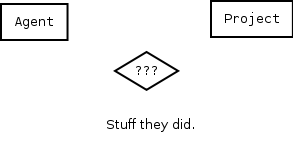
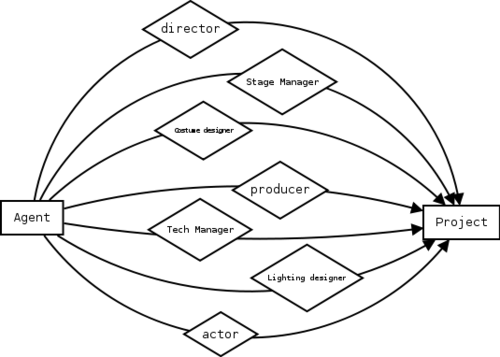
This is an easy-to-understand approach, that would work well if there were a limited number of stuff they dids. However, in real life, there is a vast number of stuff they dids and each production is different. If I took this approach, the ontology would be full of predicates for obscure stuff they dids and I’d have to update it every time someone came up with a new one.
Solution 2
This solution was suggested to me at Culture Hackday. Rather than having lots of unrelated predicates linking Agents to Projects, each of these predicates would be a subProperty of a predicate defined in the ontology.
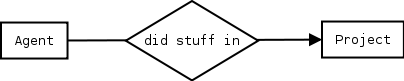
This would mean that I’d only have to include the more common stuff they dids in the ontology. If someone else wanted to use some obscure stuff they did, then they could write their own ontology which creates a new subProperty for it. So in our example:
<http://example.org/director> rdfs:subPropertyOf ex:didstuffin.
<http://example.org/alice> <http://example.org/director> <http://example.org/foomacbeth>.
This is certainly a clean and logical approach. However, it does require people to write their own ontology in order for the theatre ontology to be useful. After discussing this option with some people, I decided that that would be too big a barrier.
Solution 3
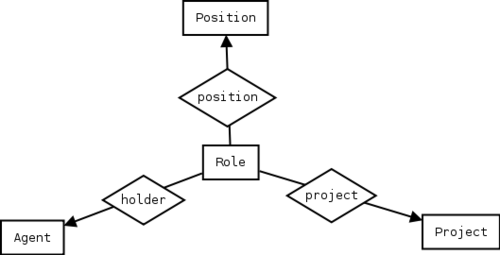
The first two approaches represented stufftheydid using predicates. This approach uses a class called Position. Obviously linking three classes (Agent, Project and Position) can’t be done using a single triple, so I used a fourth class, Role, to join them all up. (In fact, I found an existing Role class in the Participation Schema)
Whilst this method is a bit more verbose, it means that no stufftheydids are included in the ontology whilst, at the same time, others aren’t required to write their own ontologies.
So, our example becomes:
_:role rdf:type ex:Role;
        ex:holder <http://example.org/alice>;
        ex:position <http://example.org/director>;
        ex:project <http://example.org/foomacbeth>.
Conclusions
In the end, I opted for solution 3 for the reasons mentioned above.
(As usual, any feedback would be much appreciated).